

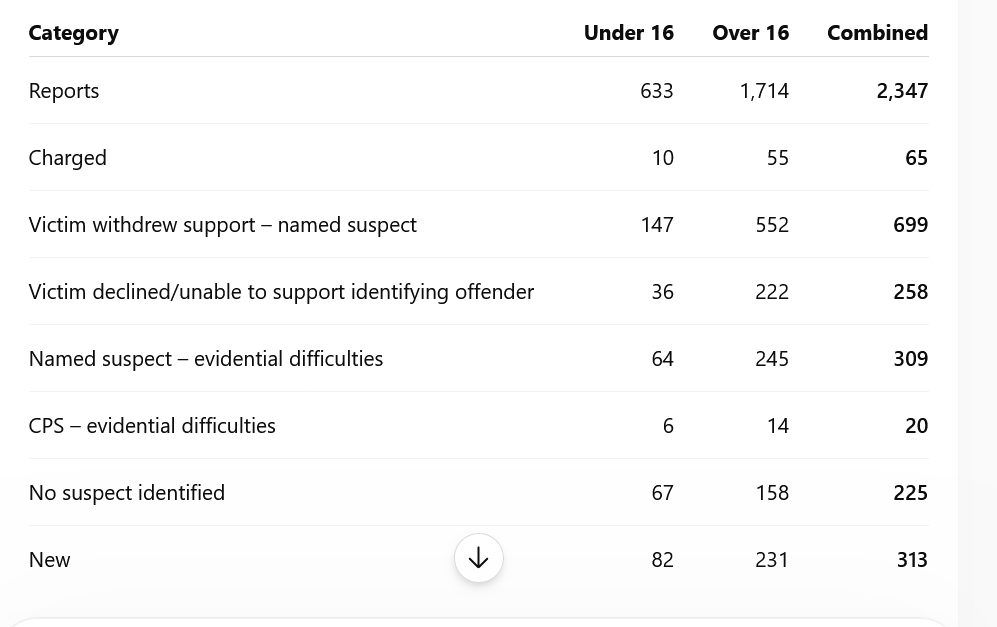
More than 2,300 rape and sexual assault reports were recorded by Dorset Police in just one year — yet only 65 of those reports were recorded as resulting in a charge.
Figures released by Dorset Police under the Freedom of Information Act reveal the scale of reports received by the force between 1 April 2025 and 31 March 2026.
The figures show 633 reports involving children aged over 12 months and under 16, alongside 1,714 reports involving people aged over 16.
That is a combined 2,347 reported sexual assaults and rapes during the 12-month period.
But the outcome figures raise difficult questions about what happens after victims make a report.
According to the force's own data, just 10 cases involving under-16s resulted in a charge, while 55 adult cases resulted in a charge.
That is 65 charges across the 2,347 reports recorded.
View the full Dorset Police FOI disclosure: https://www.dorset.police.uk/foi-ai/dorset-police/disclosure-logs/2026-disclosures/rapes--sexual-assaults/
Hundreds of cases ended after victims withdrew support
One of the most striking figures concerns cases where a suspect had been identified but the victim subsequently declined or withdrew support.
Among under-16 cases, 147 reports were recorded under the category:
"Victim declines/withdraws support - named suspect identified."
For adults, the figure was considerably higher, at 552 cases.
That means 699 reports across the two age groups were recorded under this particular outcome.
There were also 258 cases where victims were recorded as declining or being unable to support action to identify an offender.
These figures highlight one of the central difficulties surrounding sexual offence investigations: reporting an allegation does not necessarily mean a victim will ultimately be able to, or want to, support a prosecution.
More than 300 cases had a named suspect but evidential difficulties
The FOI disclosure also records hundreds of cases where a suspect was named or identified and the victim supported police action, but investigators recorded evidential difficulties.
For under-16s, there were:
64 cases where police recorded a named suspect and evidential difficulties.
6 cases involving the CPS under the same broad category.
For adults, there were:
245 cases recorded by police.
14 cases involving the CPS.
That amounts to 329 reports involving evidential difficulties where a named suspect was recorded and the victim supported action.
The average time recorded for these investigations ranged from 106 to 235 days for the under-16 cases, and 120 to 225 days for the adult cases, depending on the recorded outcome.
225 investigations had no suspect identified
The figures also show 67 under-16 investigations and 158 adult investigations were recorded as:
"Investigation complete no suspect identified."
That's a combined 225 investigations where police recorded that the investigation had been completed without identifying a suspect.
For victims, that can leave a deeply troubling question: what happens when an allegation is reported but investigators cannot identify the person responsible?
Hundreds of cases remain recorded as "New"
Another figure likely to attract attention is the number of reports still recorded as "New" in the FOI data.
There were:
82 under-16 cases
231 adult cases
A total of 313 reports therefore remained recorded as "New" in the information supplied to the FOI requester.
Dorset Police says the average number of days was calculated using the recorded reporting and finalisation dates.
The average was 73 days for the under-16 group and 75 days for adults.
However, the force does not provide an average period for cases still listed as "New".
The uncomfortable numbers
The figures present a stark picture.
The figures should not be interpreted as meaning that only 65 offences occurred, nor that the remaining reports were false.
A police report is an allegation or recorded crime report, not a finding of guilt.
Equally, the absence of a charge does not establish that an allegation was untrue.
There can be many reasons why a case cannot proceed, including evidential difficulties, victim withdrawal, an unidentified suspect, prosecution time limits and decisions about the public interest.
But the numbers nevertheless raise legitimate questions about how effectively the criminal justice system is able to convert reports of serious sexual offences into prosecutions and convictions.
The question Dorset deserves to ask
With 2,347 reports recorded in a single year, the question is not simply how many people were charged.
It is also why so many investigations did not result in a charge and whether there are recurring barriers preventing cases from progressing.
The FOI data itself does not answer those questions.
It does, however, provide a detailed snapshot of what happened to the reports after they entered the policing system.
For victims, the outcome of a report can be just as important as the initial response.
And when hundreds of cases end because a victim withdraws support, hundreds more encounter evidential difficulties, and hundreds remain listed as new, there is a wider conversation to be had about victim support, investigative processes, evidence gathering and access to justice.
Dorset Police's own figures
The disclosure was supplied by the force's Performance Analysis Department following an FOI request referenced 01/FIN/26/004925/O.
The disclosure was published with a version date of 14 August 2026.
Dorset Police recorded 633 reports involving children under 16 and 1,714 involving people over 16, giving a combined total of 2,347 reports for the period covered.
The figures are Dorset Police's recorded data and should be understood within the definitions and outcome categories used by the force.
Dorset Gazette will continue to examine official crime and policing data and ask questions about what the figures mean for communities across Dorset.
Support for rape and sexual assault
If you or someone you know has experienced rape or sexual assault, support is available. You do not have to report an incident to the police to access support.
Rape Crisis England & Wales
Free, confidential specialist support for women and girls affected by rape, sexual assault, harassment or abuse.
📞 0808 500 2222
🌐 rapecrisis.org.uk
The 24/7 Rape and Sexual Abuse Support Line
Freephone support for anyone aged 16 or over who has experienced sexual violence or abuse.
📞 0808 500 2222
Support is available 24 hours a day, 7 days a week.
Dorset Sexual Assault Referral Centre (SARC)
Provides specialist medical, forensic and emotional support following rape or sexual assault. You can contact a SARC even if you do not want to report the incident to the police.
If you are in immediate danger
Call 999.
For non-emergency police matters, call 101 or report an incident through Dorset Police.